# Upload Outgoing Payments

An outgoing payment is any payment that is going toward a vendor, customer, or third party and is distinct from settling a bill or invoice. An outgoing payment is made when you want to make any payment right away. You can import the outgoing payments in bulk using the steps mentioned below:

* Download the latest CSV template from the “**Upload Outgoing Payments**” module.
* Copy Outgoing Payment(s) information into the CSV template.
* Upload the CSV template into Xoro.

### Downloading the CSV template

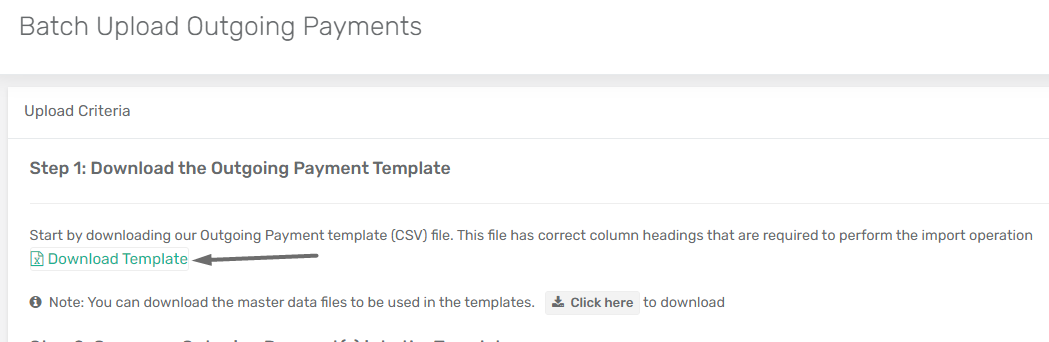
* Go to the Upload Outgoing Payments module using the search menu.
* Click on the “**Download Template**“.

  <div align="left"><figure><img src="/files/v0fa5YEJH6Pw54JFm7q6" alt=""><figcaption></figcaption></figure></div>

### Copying the information into the template

Once you’ve downloaded the template file, you can copy your data using any spreadsheet software. There are columns that you must complete and others that are optional. Mandatory fields are marked with a double asterisk (\*\*) prefix.

Below are some points to be noted when entering the data into the template.

* The file must be a CSV (Comma-separated values) file. The name of your file must end with csv.
* Make sure you don’t change any of the column headings from row 1 in the template as these are needed for the file to import correctly.
* All date fields will accept the MM-DD-YYYY format.
* Be mindful of any leading zeros in your data, some spreadsheet software will trim them automatically without notifying you. This can be resolved by ensuring your columns have correct formatting.
* Sometimes long numbers (UPC, etc.) are formatted as scientific notation. Be sure to change the formatting on this data to display these long numbers correctly.

{% hint style="info" %}
If you’re importing more than 5,000 records, we recommend you split up the file.
{% endhint %}

<figure><img src="/files/XEq49QLKKrTN9vpbTdmC" alt=""><figcaption></figcaption></figure>

#### Upload Outgoing Payment Template Fields

<table><thead><tr><th width="238">Column Name</th><th width="119">Data Type</th><th>Description</th></tr></thead><tbody><tr><td>**ThirdPartyRefNo</td><td>Text</td><td>This field allows you to enter a unique payment number representing single bank transaction.</td></tr><tr><td>ThirdPartySource</td><td>Text</td><td>This field allows you to enter a keyword to identify the source of the payment.</td></tr><tr><td>**TxnDate</td><td>Date</td><td>Specify the transaction date of the outgoing payment.</td></tr><tr><td>**EntityName</td><td>Text</td><td>Enter the payee name (Customer, Vendor or Store) for the payment line.</td></tr><tr><td>EntityNameDisplay</td><td>Text</td><td>Enter a display name for the payee.</td></tr><tr><td>**EntityTypeName</td><td>Text</td><td>Select the type of entity to associate with this outgoing payment (Customer, Vendor or Store).</td></tr><tr><td>**PaymentAccountName</td><td>Text</td><td>This account will get credited for the outgoing payment. Click to automatically calculate this value.</td></tr><tr><td>**PaymentMethodName</td><td>Text</td><td>Enter the payment method for the transaction (Cash, Cheque, Visa, MasterCard, etc.).</td></tr><tr><td>ChequeNo</td><td>Text</td><td>This field applies if the payment method is a cheque. Enter the cheque number to associate with this outgoing payment.</td></tr><tr><td>Memo</td><td>Text</td><td>If required, enter any notes or additional information for the outgoing payment.</td></tr><tr><td>RefNo</td><td>Text</td><td>This field allows you to assign a unique reference number or identifier to the outgoing payment for easy tracking and reference purposes.</td></tr><tr><td>ExchangeRate</td><td>Numeric</td><td>In case of foreign transactions, this field allows you to specify the conversion rate for currency exchange. </td></tr><tr><td>EntityFirstName</td><td>Text</td><td>Enter the entity is "Customer" or "Vendor", enter the first name of the entity here.</td></tr><tr><td>EntityLastName</td><td>Text</td><td>Enter the entity is "Customer" or "Vendor", enter the last name of the entity here.</td></tr><tr><td>EntityAddr</td><td>Text</td><td>Enter the address details of the entity.</td></tr><tr><td>EntityAddr2</td><td>Text</td><td>This is an additional field for the address of the entity, in case the address is long.</td></tr><tr><td>EntityCity</td><td>Text</td><td>Enter the city associated with the entity.</td></tr><tr><td>EntityState</td><td>Text</td><td>Enter the state associated with the entity.</td></tr><tr><td>EntityCountry</td><td>Text</td><td>Enter the country associated with the entity.</td></tr><tr><td>EntityZipPostalCode</td><td>Text</td><td>Enter the zip code associated with the entity.</td></tr><tr><td>EntityPhone</td><td>Numeric</td><td>Enter the phone number associated with the entity.</td></tr><tr><td>EntityEmail</td><td>Text</td><td>Enter the email associated with the entity.</td></tr><tr><td>ToBePrinted</td><td>Text</td><td>Enter "Y" if you want to add the cheque to the Print queue to print later. The cheque number will be automatically generated by the system - it is incremented from the previous cheque number stored in the system. </td></tr><tr><td>StoreName</td><td>Text</td><td>If required, enter a store to associate with the payment line.</td></tr><tr><td>**ExpenseAccountName</td><td>Text</td><td>Select an expense account for the payment line.</td></tr><tr><td>ExpenseMemo</td><td>Text</td><td>If required, enter a memo for the payment line.</td></tr><tr><td>**Amount</td><td>Numeric</td><td>Enter the amount associated with the payment line.</td></tr><tr><td>CustomerJobName</td><td>Text</td><td>If the payment is linked to a customer entity that has a child customer, this field allows you tot enter the child customer name associated with the primary customer.</td></tr><tr><td>TaxItemCode1</td><td>Text</td><td>Enter the code for the first tax item (if applicable).</td></tr><tr><td>TaxItemValue1</td><td>Text</td><td>Enter the value of the first tax item.</td></tr><tr><td>TaxItemCode2</td><td>Text</td><td>Enter the code for the second tax item (if applicable).</td></tr><tr><td>TaxItemValue2</td><td>Text</td><td>Enter the value of the second tax item.</td></tr><tr><td>TaxItemCode3</td><td>Text</td><td>Enter the code for the third tax item (if applicable).</td></tr><tr><td>TaxItemValue3</td><td>Text</td><td>Enter the value of the third tax item.</td></tr><tr><td>TaxItemCode4</td><td>Text</td><td>Enter the code for the fourth tax item (if applicable).</td></tr><tr><td>TaxItemValue4</td><td>Text</td><td>Enter the value of the fourth tax item.</td></tr><tr><td>IgnoreLine</td><td>Text</td><td>This field allows you to skip a payment line during upload (if needed). Enter "Y" to ignore the line.</td></tr><tr><td>ProjectClassName</td><td>Text</td><td>Enter the project/class to associate with this outgoing payment.</td></tr><tr><td>ImportError</td><td>Text</td><td>If there are any errors from an upload, they will be listed in this column.</td></tr></tbody></table>

### Uploading the template

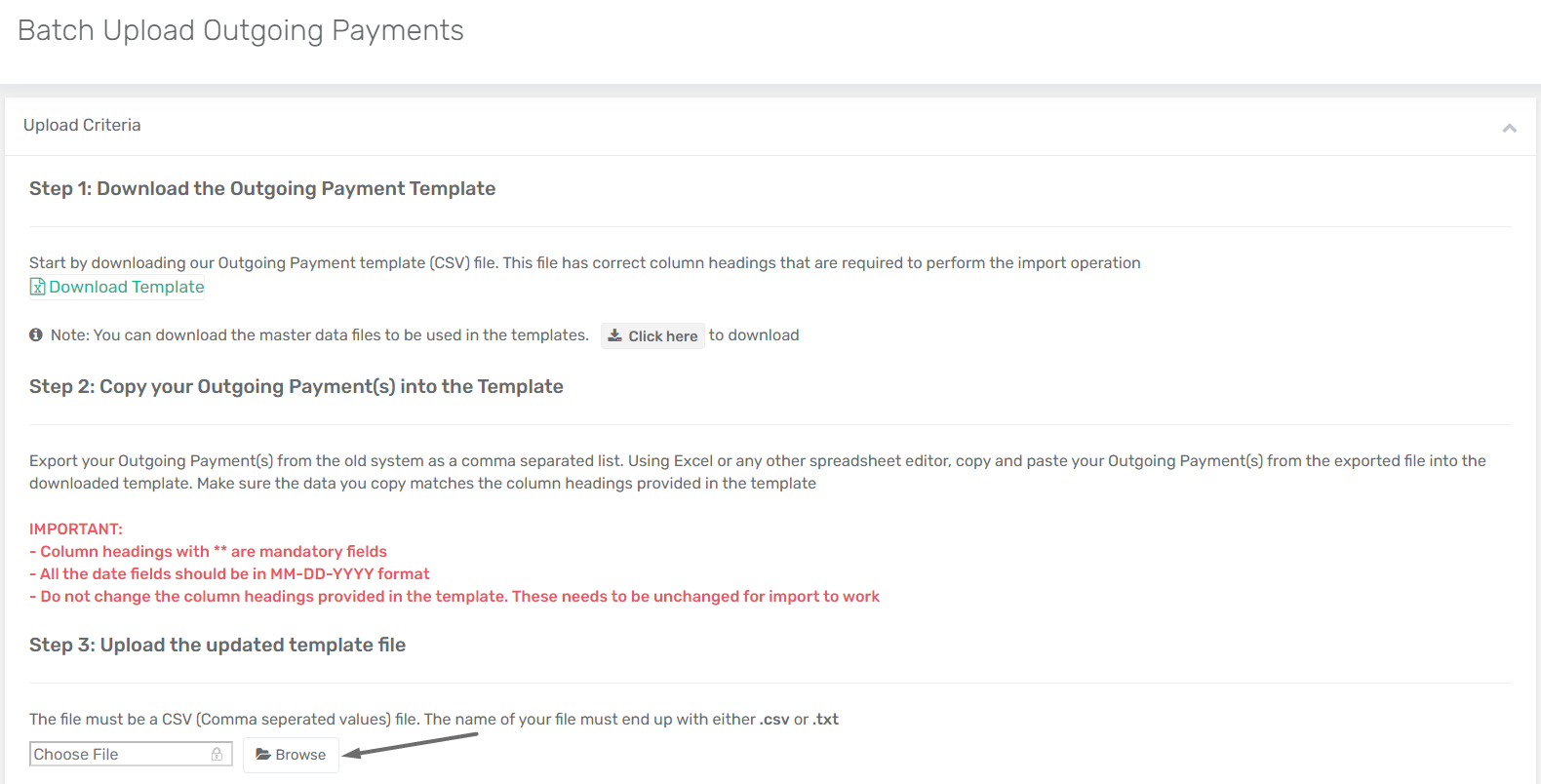
Once you have filled out the CSV file with your data, you can follow the steps below to upload it into Xoro:

* Click **Browse** to select the saved CSV template file.

  <figure><img src="/files/Od4tY1ghLrdGTPDhndik" alt=""><figcaption></figcaption></figure>
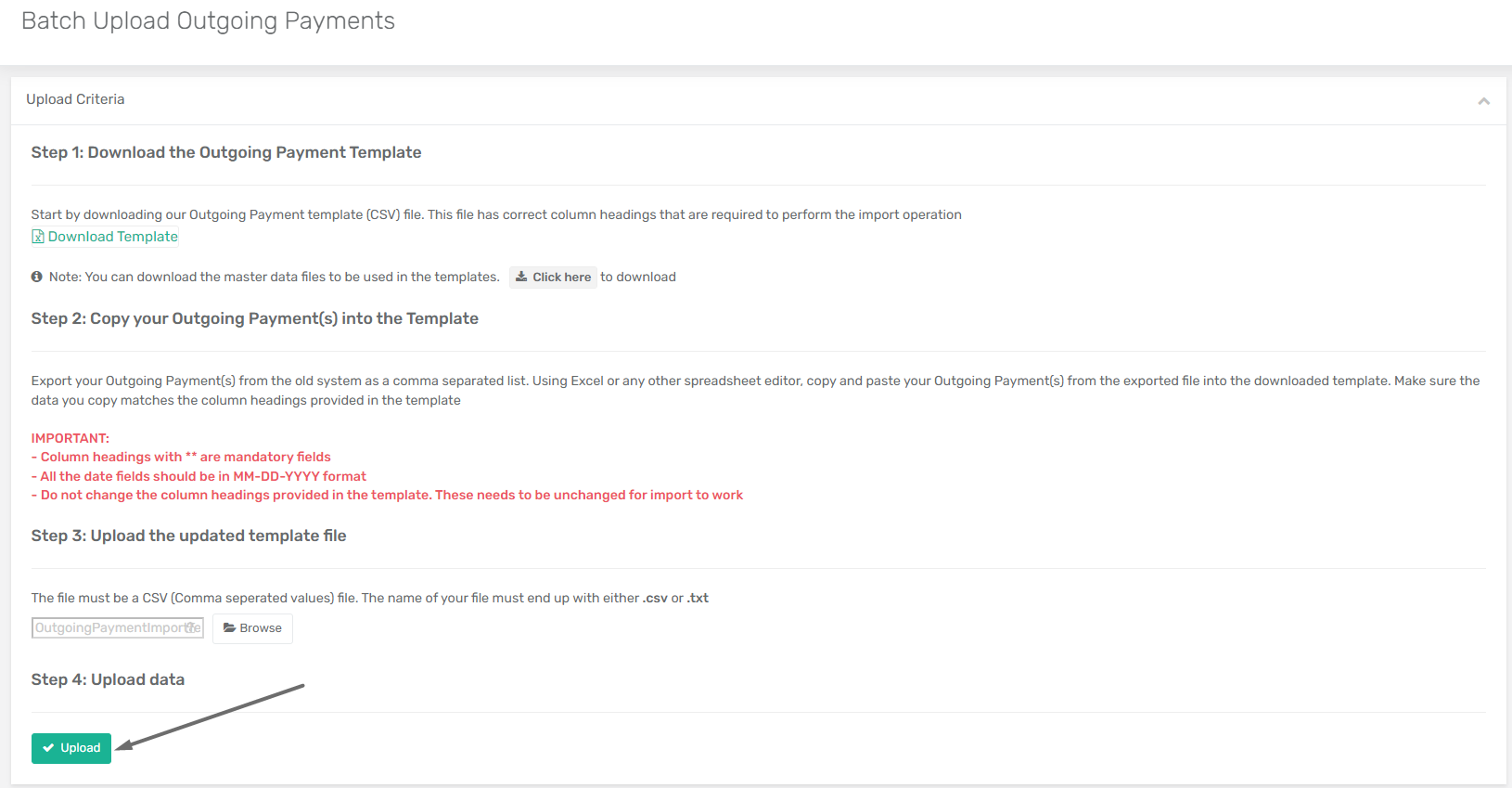
* After the file has been selected, click on **Upload** to start importing.

  <figure><img src="/files/RPcqs05xkOycFoD0s1Ks" alt=""><figcaption></figcaption></figure>
* While the import is in progress, the summary of the progress will be displayed at the bottom of the screen with the progress bar.
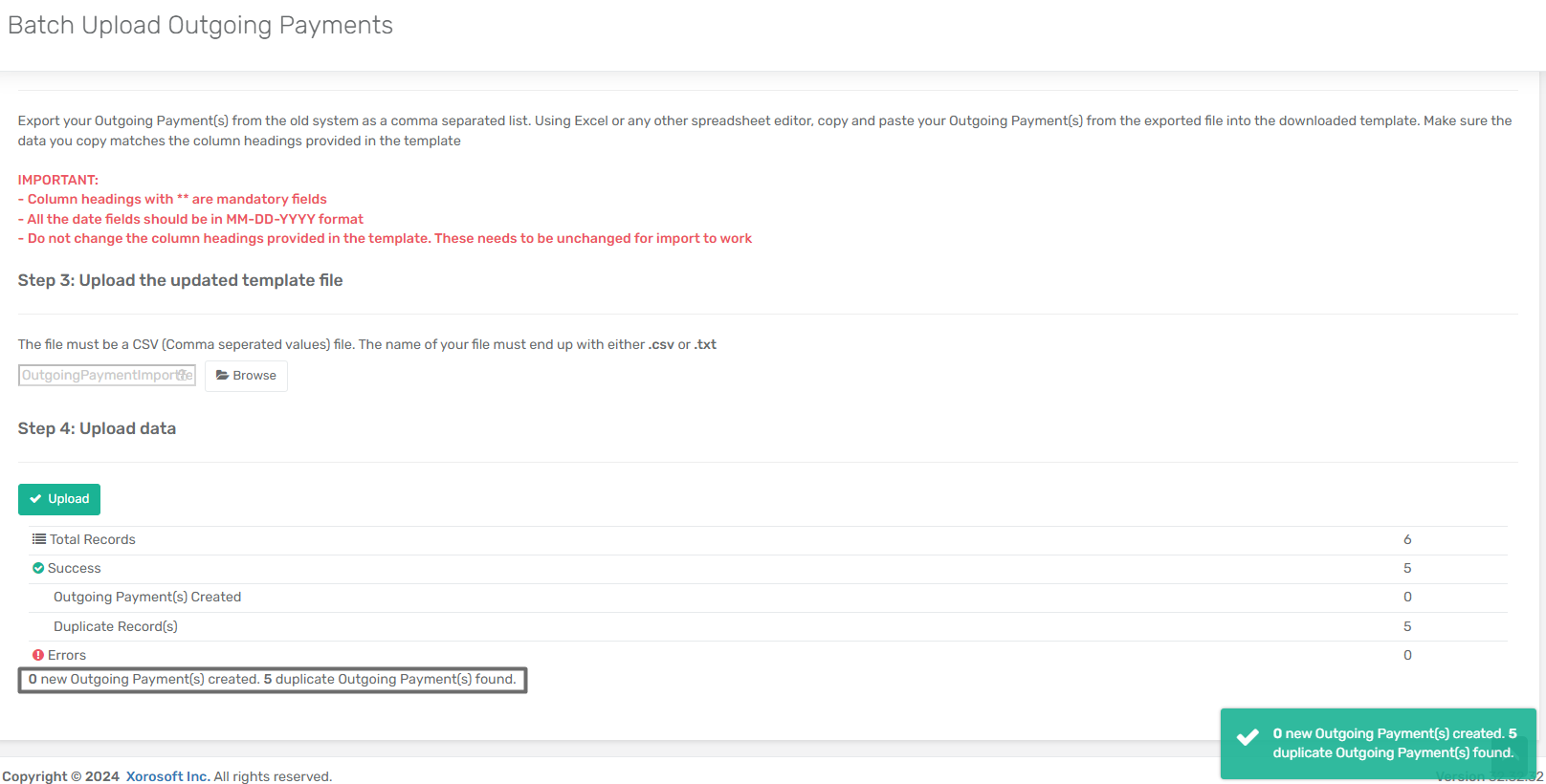
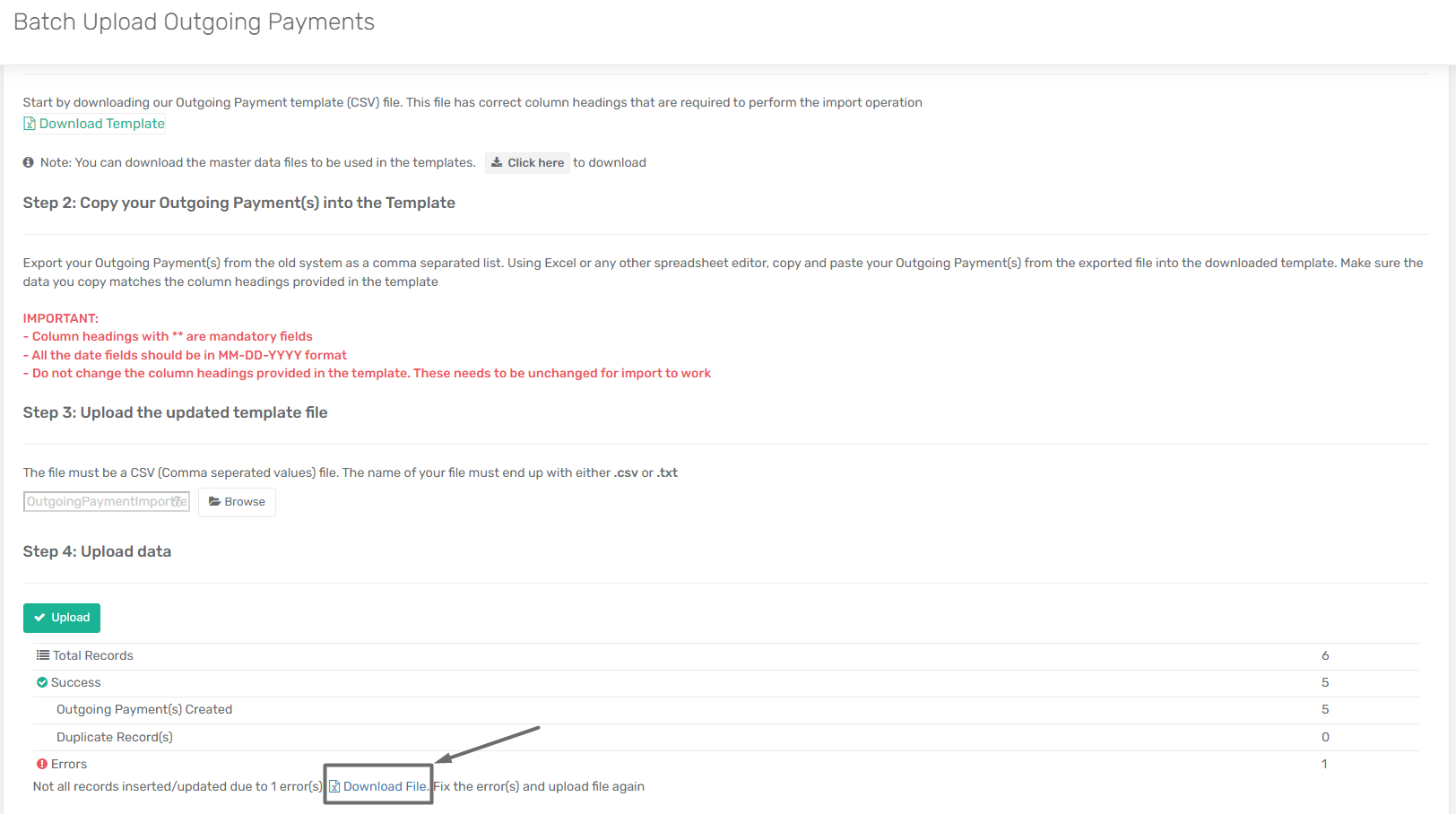
* After the import has been completed, the result will be displayed with the message for success or error (if any).

  <figure><img src="/files/uuFIawWe3dubNXaFKmcs" alt=""><figcaption></figcaption></figure>
* Outgoing Payments will only get uploaded into the system if there are no errors in the file.
* If there are errors in the file, you can download the error file, fix the errors in the **original file,** and upload it back into Xoro.

  <figure><img src="/files/J4HbUlw14PbLQ9K3VUXS" alt=""><figcaption></figcaption></figure>


---

# Agent Instructions: Querying This Documentation

If you need additional information that is not directly available in this page, you can query the documentation dynamically by asking a question.

Perform an HTTP GET request on the current page URL with the `ask` query parameter:

```
GET https://docs.xorosoft.com/xoroerp-1/utilities/data-imports/upload-outgoing-payments.md?ask=<question>
```

The question should be specific, self-contained, and written in natural language.
The response will contain a direct answer to the question and relevant excerpts and sources from the documentation.

Use this mechanism when the answer is not explicitly present in the current page, you need clarification or additional context, or you want to retrieve related documentation sections.