# The Custom Field Mapping module

The Custom Field Mapping Centre is used to link or map the custom fields from one module to the custom fields of another. Linking these fields provides you with the ability to seamlessly transfer and synchronize data across various modules. For instance, if you link the custom fields of an item to the custom fields at the sales order detail level, the data can be seen at the sales order detail level.

The available mapping options include:

* ***Customer to Sales Order/Estimate/Invoice/Sales Order Detail/Estimate Detail/Invoice Item Line/RMA/Credit Memo***
* ***Item*** to ***Sales Order Detail/Estimate Detail/Invoice Item Line/Purchase Order Detail/Credit Memo Line/RMA Detail/Bill Of Material Item Line/Item Receipt Line Detail/Bill Item Line Detail/Sales Receipt Item Line***
* ***Sales Order*** to ***Invoice/Invoice Item Line/Packing Slip/Packing Slip Detail***
* ***Sales Order Detail*** to ***Invoice Item Line/Packing Slip Detail***
* ***Vendor*** to ***Purchase Order Detail/Purchase Order/Item Receipt/Bill***
* ***Bill of Material*** to ***Manufacturing Order***
* ***Bill Of Material Item Line*** to ***Manufacturing Order Item Lines***
* ***Purchase Order*** to ***Item Receipt/Bill/ASN Detail***
* ***Purchase Order Detail*** to ***Item Receipt Line Detail/Bill Item Line Detail/ASN Detail***
* ***Item Receipt Line Detail***  to ***Bill Item Line Detail***

### Creating the Custom Field Mapping

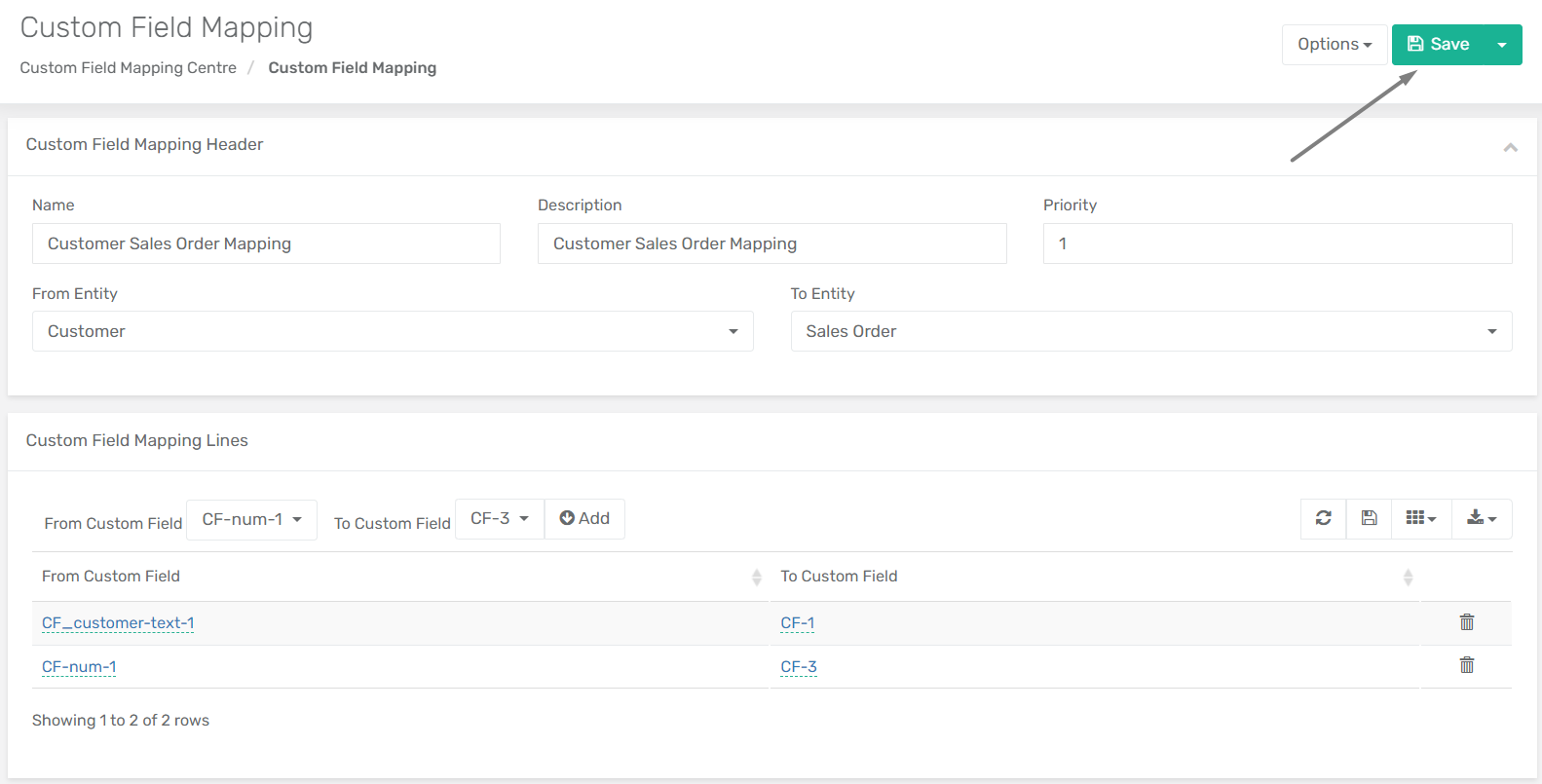
When creating a custom field mapping, begin by adding the name, description, and priority for the mapping. After that, select the entities to be mapped. You can then select the specific custom fields to map.

<figure><img src="/files/CZWzMXKFtRcV0nlzLAd6" alt=""><figcaption></figcaption></figure>

**Custom Field Mapping Header Fields**

<table><thead><tr><th width="164">Field</th><th>Description</th></tr></thead><tbody><tr><td>Name</td><td>Enter a name for the mapping. This acts as a unique identifier for the mapping and helps you locate the mapping easily when required, especially if you have multiple mappings for a single entity.</td></tr><tr><td>Description</td><td>Enter a description for the mapping.</td></tr><tr><td>Priority</td><td>Add a priority for the mapping. If the user has made a mapping for the Customer to the SO detail (having Priority 1) and also for the Item to SO Detail (having Priority 2) then the SO line will be mapped based on the minimum priority (Customer to SO line (Priority 1)).</td></tr><tr><td>From Entity</td><td>Select the source entity for the custom field mapping.</td></tr><tr><td>To Entity</td><td>Select the entity to which the source entity is being mapped. </td></tr></tbody></table>

After selecting "From Entity" and "To Entity", you can select the custom fields to map and "Add" the mapping. It is important to note that you can only map custom fields with the same data type. For instance, you can't map a "Text" type field with a "Number" type field.

<figure><img src="/files/42JNdTP2ue6313me3ut4" alt=""><figcaption></figcaption></figure>

**Custom Field Mapping Lines Fields**

<table><thead><tr><th width="199">Field</th><th>Description</th></tr></thead><tbody><tr><td>From Custom Field</td><td>Select the custom field corresponding to the source entity.</td></tr><tr><td>To Custom Field</td><td>Select the custom field to be mapped with the custom field of the source entity.</td></tr><tr><td>Add</td><td>Click to add the custom field mapping.</td></tr></tbody></table>

Repeat this process for all the custom fields that you want to map. After adding the mappings, click on "Save" to create the mapping.

<figure><img src="/files/im3QA5qHdObht1Waul2h" alt=""><figcaption></figcaption></figure>

There is an option to delete the individual mapping, and the option to batch delete the mapping is available in this module.

<figure><img src="/files/NEdf4pDhtdM5FpA6Nxzw" alt=""><figcaption></figcaption></figure>


---

# Agent Instructions: Querying This Documentation

If you need additional information that is not directly available in this page, you can query the documentation dynamically by asking a question.

Perform an HTTP GET request on the current page URL with the `ask` query parameter:

```
GET https://docs.xorosoft.com/xoroerp-1/admin/custom-field-mapping/the-custom-field-mapping-module.md?ask=<question>
```

The question should be specific, self-contained, and written in natural language.
The response will contain a direct answer to the question and relevant excerpts and sources from the documentation.

Use this mechanism when the answer is not explicitly present in the current page, you need clarification or additional context, or you want to retrieve related documentation sections.