> For the complete documentation index, see [llms.txt](https://docs.xorosoft.com/llms.txt). Markdown versions of documentation pages are available by appending `.md` to page URLs; this page is available as [Markdown](https://docs.xorosoft.com/xoroerp-1/apps-and-integrations/sales-channels/shopify-app-logs.md).
# Shopify App Logs
### What are Shopify App Logs?
In XoroERP, the Shopify Sales Channel App provides multiple tabs to view and track various transactions, ensuring efficient monitoring and management of your Shopify operations.
**Tabs in the Shopify Sales Channel App:**
1. **Order:**
* Tracks all order-related transactions, providing insights into sales order activities.
2. **Inventory:**
* Monitors inventory updates and adjustments, ensuring stock levels are accurately reflected.
3. **Fulfillment:**
* Records fulfillment activities, including shipments and delivery status.
4. **SKU:**
* Manages SKU-related data, tracking changes and updates to product information.
5. **Logs:**
* Maintains a detailed log of all transactions, offering a comprehensive audit trail.
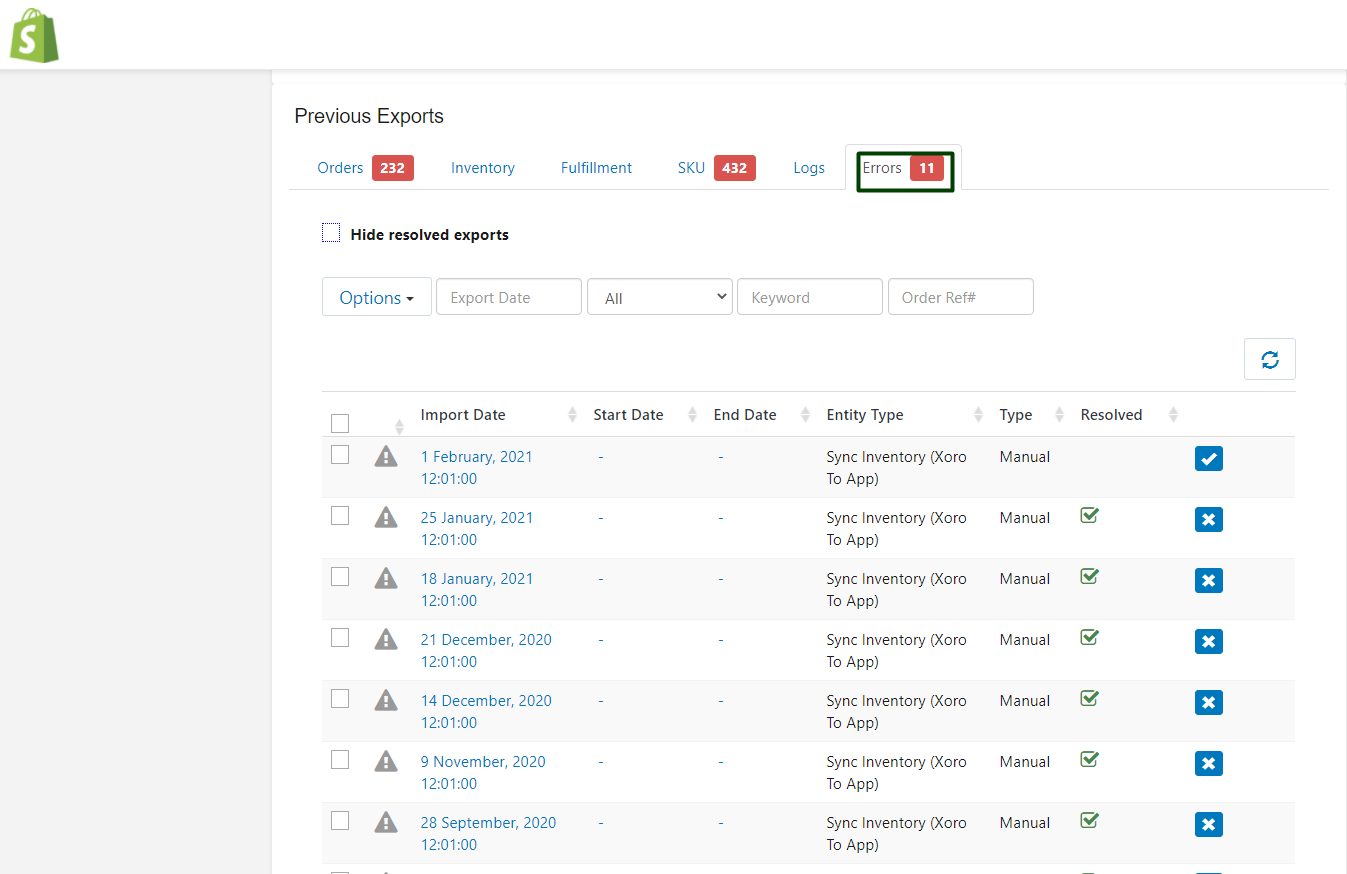
6. **Errors:**
* Captures any errors encountered during transactions, facilitating quick identification and resolution.
### **Features within Each Tab:**
* **Hide Resolved Exports / Show Errors Only:**
* By checking the respective flags, users can filter the view to hide resolved exports or display only errors. This feature helps in focusing on pending issues and reducing clutter from resolved items.
* **Options Dropdown:**
* Provides additional actions for managing logs:
* **Re-Run the Log:** Allows users to re-execute a specific transaction log to correct or verify data.
* **Mark as Resolved:** Flags the log as resolved, helping in tracking the status of each transaction.
* **Mark as Unresolved:** Reverses the resolved status, indicating that the issue requires further attention.
### Detailed Overview of Shopify Sales Channel App Logs:
**Order Logs:**
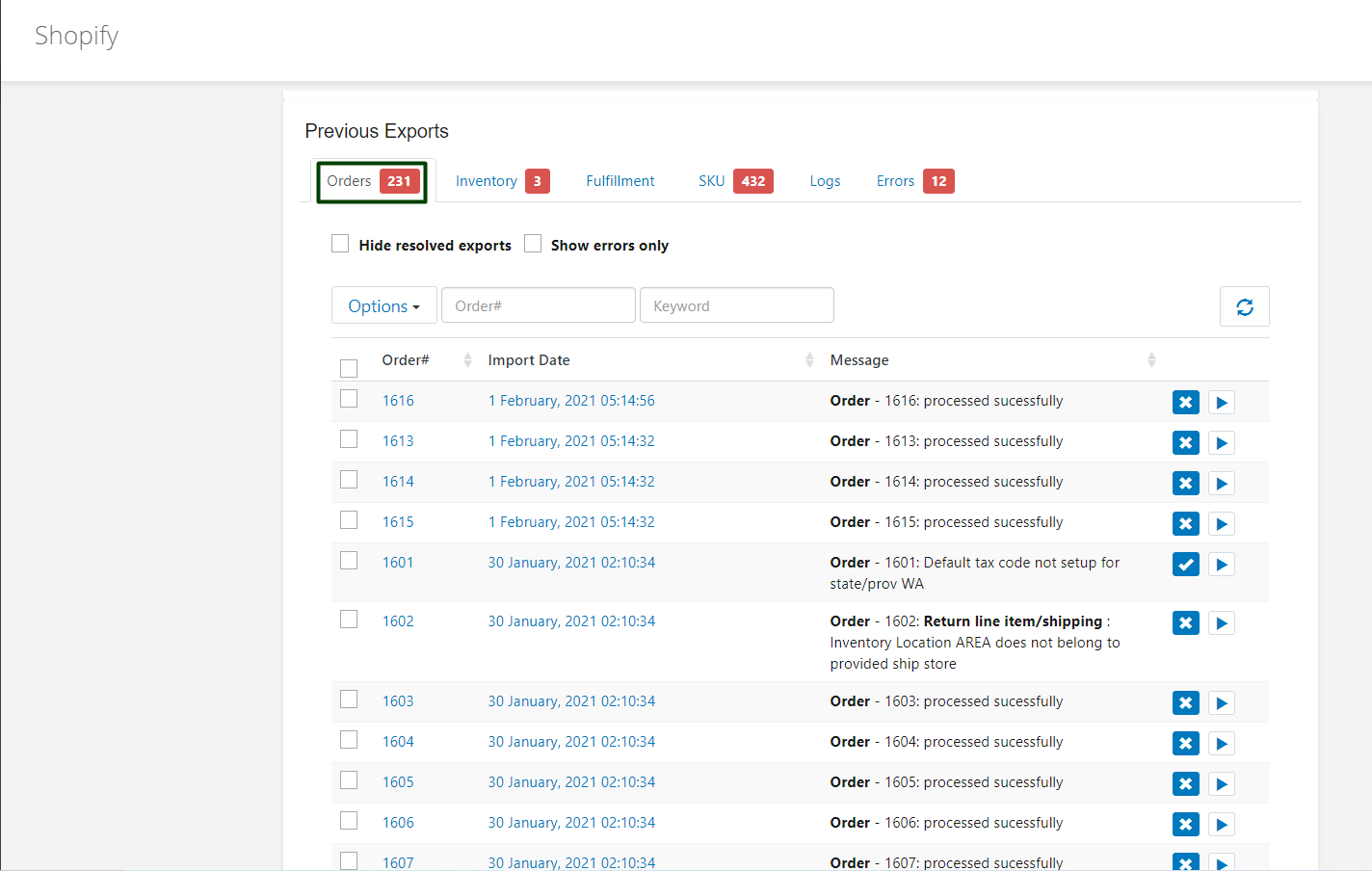
The Order Shopify App Log in XoroERP is an essential tool for tracking and managing orders created in Shopify and processed through the Xoro-Shopify integration.
**Order Processing Workflow:**
1. **Order Creation in Shopify:**
* Once an order is placed in Shopify, it is automatically pushed to XoroERP via the integration.
2. **Order Status in XoroERP:**
* Initially, the order appears as "**Pending**" in the "**Orders Tab**" of the Shopify Sales Channel App. This status indicates that the order is awaiting processing.
* According to the settings defined in the Shopify Sales Channel App, the order should auto-process, transitioning from "Pending" to a processed state.
3. **Viewing Orders in XoroERP:**
* Successfully processed orders are transferred into XoroERP and can be viewed in the "**Sales Order Centre**" or "**Invoice Centre.**" This integration ensures seamless order management and visibility across platforms.
4. **Error Handling:**
* If the system encounters any errors during the import process, the order will not be imported into XoroERP. These errors are logged and can be viewed under the "Errors Tab."
* By reviewing the "**Errors Tab**," users can identify and address issues preventing the order from being imported, ensuring timely resolution.
5. **Searching and Filtering Orders:**
* Users can search for specific orders by entering the Order Number or relevant keywords. This functionality allows for quick and efficient tracking of order statuses and details.
### **Inventory Logs:**
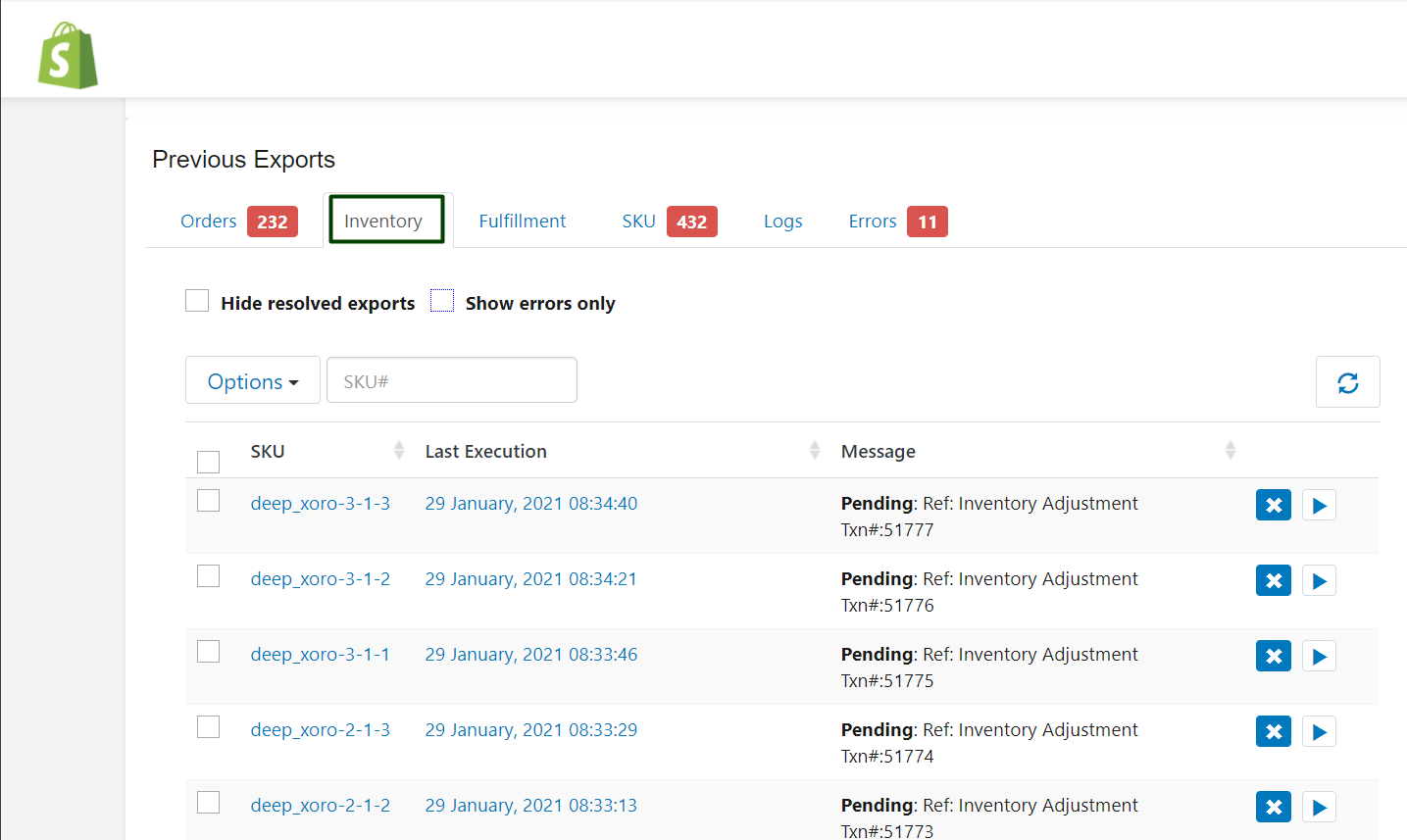
The Inventory Shopify App Log in XoroERP allows for detailed tracking and management of inventory adjustments made in stores mapped to the Shopify Sales Channel App.
**Inventory Adjustment Tracking:**
1. **Viewing Adjustments:**
* Any adjustment made to the inventory in a store mapped with the Shopify Sales Channel App can be viewed in the "Inventory Tab." This includes all types of transactions related to inventory, ensuring comprehensive visibility.
2. **Log Creation:**
* Each inventory transaction generates a log entry under the "Inventory Tab." This log provides a detailed record of all inventory movements and adjustments, facilitating accurate tracking and auditability.
3. **Filtering Logs:**
* To find specific inventory logs, users can filter by SKU number. This search functionality allows for quick retrieval of relevant logs, improving efficiency in inventory management.
### **Fulfillment Logs:**
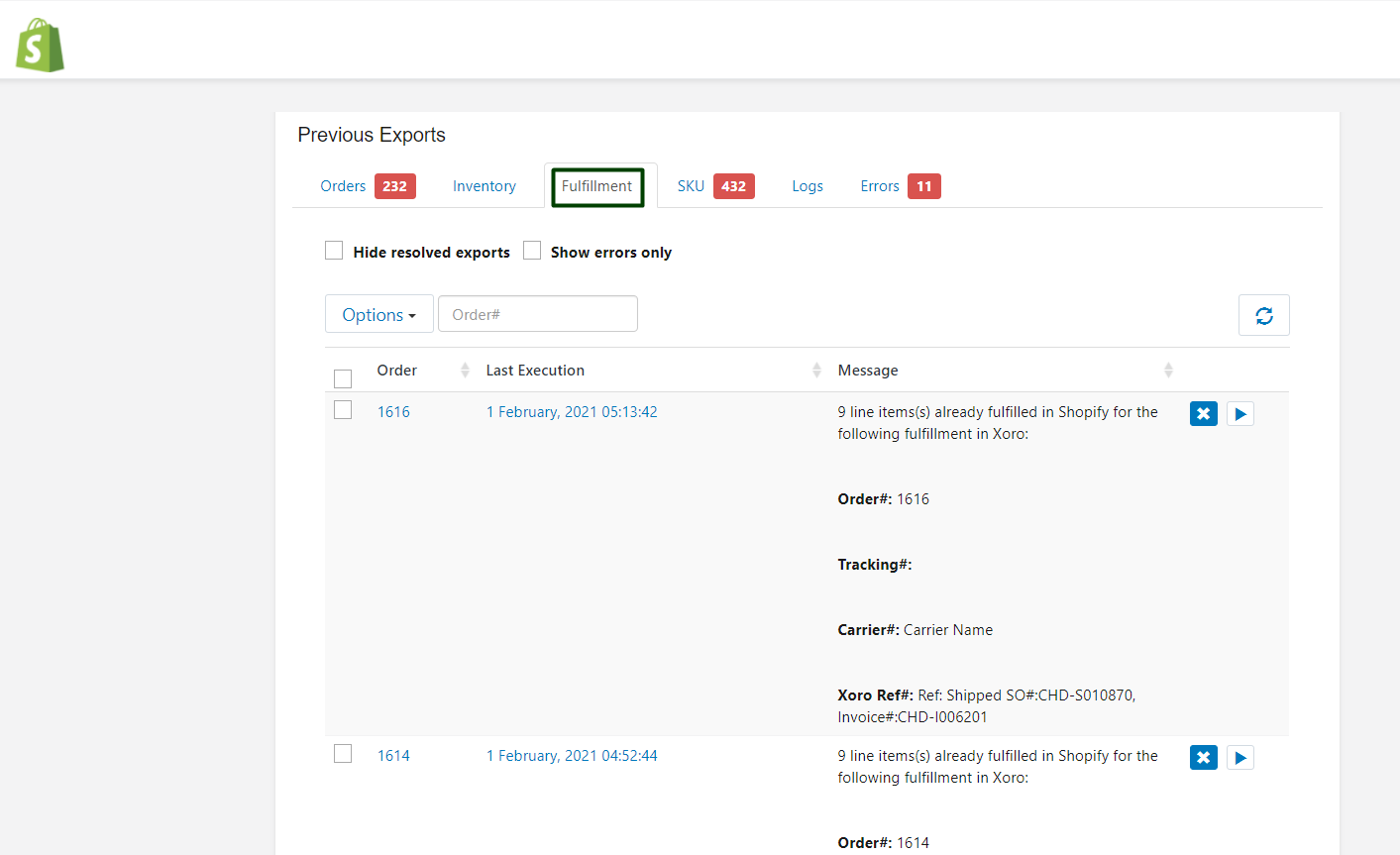
The Fulfillment Log tab in XoroERP's Shopify App provides a comprehensive view of all fulfilled orders, ensuring efficient tracking and management of order fulfillment.
**Key Information Displayed:**
* **Xoro Ref#:**
* The reference number assigned by XoroERP to track the fulfillment process.
* **Execution Date:**
* The date when the fulfillment action was executed, providing a timeline of order processing.
* **Tracking#:**
* The tracking number is associated with the shipment, allowing users to monitor the delivery status.
* **Carrier#:**
* The carrier's reference number, identifying the logistics provider responsible for shipping the order.
* **SO# in Xoro:**
* The Sales Order number in XoroERP, linking the fulfillment log to the specific sales order.
* **Order Status:**
* The current status of the order, indicating whether it is pending, fulfilled, or in another stage of processing.
* **Invoice#:**
* The invoice number is generated for the fulfilled order, ensuring financial tracking and reconciliation.
#### How to Use the Fulfillment Log:
1. **Navigate to the Fulfillment Log Tab:**
* Access the Fulfillment Log tab within the Shopify Sales Channel App to view detailed records of all fulfilled orders.
2. **Review Fulfillment Details:**
* Examine the information displayed in the log, including reference numbers, execution dates, tracking numbers, carrier details, sales order numbers, order statuses, and invoice numbers.
3. **Monitor and Manage Fulfilled Orders:**
* Use the comprehensive data provided in the log to track the progress of fulfilled orders, resolve any issues, and ensure timely delivery.
### **SKU Logs:**
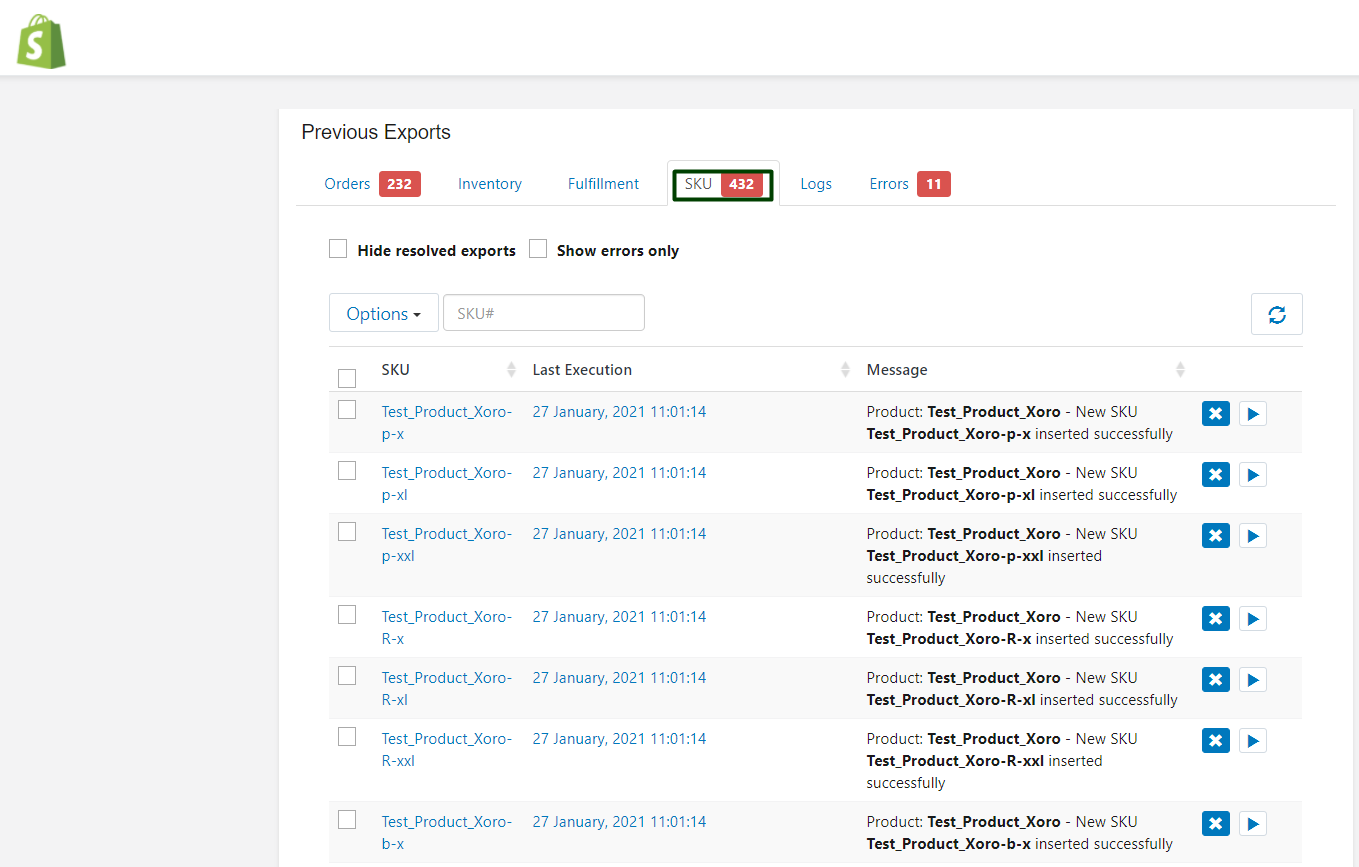
The Fulfillment Log tab in XoroERP's Shopify App is an essential tool for recording and managing all activities related to product updates and creations between XoroERP and Shopify.
**Key Functions:**
* **Activity Recording:**
* This tab captures all activities related to product updates and creations. Whether products are added or modified in XoroERP or Shopify, these actions are logged for comprehensive tracking.
* **Error Reporting:**
* The log includes detailed error reports associated with specific SKUs. This feature helps identify and diagnose issues that occur during the product update or creation process.
* **Error Management:**
* Users can view, re-run, and resolve errors directly from the log. This functionality ensures that any issues are promptly addressed, maintaining the integrity of the product data.
#### How to Use the Fulfillment Log:
1. **Navigate to the Fulfillment Log Tab:**
* Access the Fulfillment Log tab within the Shopify Sales Channel App to review recorded activities related to product updates and creations.
2. **Review Activity Logs:**
* Examine detailed logs of all product-related activities, ensuring all updates and creations are accurately tracked.
3. **Monitor and Resolve Errors:**
* View error reports linked to specific SKUs. Utilize the options to re-run and resolve these errors, ensuring that all product data discrepancies are corrected.
### **Logs:**
The Logs tab in XoroERP's Shopify App provides a comprehensive overview of all transactions between Shopify and XoroERP, facilitating detailed tracking and management of various operations.
**Transaction Types Recorded:**
* **Orders Dropped:**
* Tracks orders imported from Shopify into XoroERP.
* **Inventory Sync:**
* Records inventory synchronization activities from XoroERP to the Shopify App.
* **Inventory Update:**
* Logs inventory updates from XoroERP to the Shopify App.
* **Fulfillment Update:**
* Captures fulfillment updates from XoroERP to the Shopify App.
* **Link SKU:**
* Tracks the linking of SKUs between XoroERP and the Shopify App.
**Filtering Options:**
To efficiently locate specific transaction logs, you can filter the data using the following options:
* **By Export Date:**
* Filter logs based on the date the transaction was exported.
* **Transaction Type:**
* Narrow down logs by selecting the type of transaction (e.g., orders, inventory sync).
* **Keyword Search:**
* Use keywords to quickly find relevant logs.
* **Order Ref#:**
* Filter by specific order reference numbers for precise tracking.
**Information Columns:**
The recorded information for each transaction is organized under the following columns:
* **Import Date:**
* The date the transaction was imported into XoroERP.
* **Start Date & End Date:**
* The time range during which the transaction was processed.
* **Entity Type:**
* The type of entity involved in the transaction (e.g., order, inventory).
* **Resolved Status:**
* Indicates whether the transaction has been resolved or if it requires further action.
* **Sync Type (Manual/Auto):**
* Specifies whether the transaction was synchronized manually or automatically.
By utilizing the Logs tab in XoroERP's Shopify App, businesses can maintain thorough oversight of all transactions, ensuring accurate tracking, efficient management, and prompt resolution of any issues.
### **Error Logs:**
The Error Log tab in XoroERP's Shopify App is designed to help you quickly identify and address errors associated with various transactions between Shopify and XoroERP.
**Key Features:**
1. **Comprehensive Error Tracking:**
* This tab logs all errors that occur during transactions such as order imports, inventory syncs, inventory updates, and fulfillment updates.
2. **Detailed Error Information:**
* Each log entry provides detailed information about the error, including the transaction type, the specific issue encountered, and relevant identifiers like order reference numbers or SKU numbers.
3. **Efficient Data Filtering:**
* You can easily filter and find errors related to a particular transaction by using various search and filter options. This helps in quickly pinpointing and resolving issues.
**Filtering Options:**
* **By Transaction Type:**
* Filter errors based on the type of transaction, such as orders, inventory syncs, updates, or fulfillments.
* **By Export Date:**
* Narrow down the errors by the date the transaction was attempted.
* **By Keyword:**
* Use specific keywords related to the transaction to locate relevant errors.
* **By Order Ref#:**
* Search for errors using specific order reference numbers to find issues related to particular orders.
#### How to Use the Error Log:
1. **Navigate to the Error Log Tab:**
* Access the Error Log tab within the Shopify Sales Channel App to review all logged errors.
2. **Filter and Search Errors:**
* Use the available filtering options to search for errors by transaction type, date, keyword, or order reference number.
3. **Review Error Details:**
* Examine the detailed information provided for each error to understand the nature of the issue.
4. **Resolve Errors:**
* Take appropriate actions to resolve the errors, ensuring smooth and uninterrupted transaction processing between Shopify and XoroERP.
By utilizing these logs and features, businesses can maintain better control over their Shopify transactions, ensuring data accuracy and operational efficiency within XoroERP.
### **FAQs**
**Can Shopify sales channels be set in Xoro?**
**A: Yes.** Shopify can be configured as a **Sales Channel** in Xoro. Users can connect and configure one or multiple Shopify accounts in Xoro, allowing Shopify products, orders, inventory, and fulfillment information to sync with Xoro based on the configured integration settings and business requirements.
To configure a sales channel, navigate to **Menu → Apps → Sales Channels**. You can click the **Shopify channel** to configure it, or click **Add Sales Channel** to add and configure another sales channel, such as **Amazon Test** or **Woo-Commerce**.
#### **Are Shopify sales channels an item-level or product-level attribute in Xoro?**
Sales channel settings in Xoro are configured at the **item level**. Since each Xoro item corresponds to a Shopify product variant, individual variants can be synchronized between Xoro and Shopify while the parent product is published.
#### **If Shopify's variant status is manually changed, will a later Xoro sync overwrite that change?**
Once a Shopify variant is published, Xoro does not overwrite its publish status through synchronization. If the variant needs to be unpublished, the user must **manually unpublish the variant in Shopify**. After it is unpublished, Xoro can overwrite the variant's publish status through the next synchronization.
#### How can I import Shopify international orders with their tax information into XoroERP?
XoroERP supports importing Shopify orders with international tax information. However, the required tax records and tax configuration must be in place to ensure that the imported tax values are handled correctly.
Follow these steps:
1. Decide whether XoroERP should retain the tax amounts received from Shopify or calculate taxes based on its own tax configuration.
2. Navigate to **App Config → General**.
3. Review the **Auto-create tax operation records for other countries** configuration.
4. Select the appropriate option:
* **Do Not Create:** Required foreign tax records must already exist in XoroERP.
* **One tax item per state/prov:** Allows XoroERP to create separate tax records for each state or province.
* **One tax item per country:** Allows XoroERP to create a tax record for each country.
5. Verify that the destination country and state/province information is correct.
6. Ensure that the incoming tax information matches the configured tax records or applicable default-tax configuration. Verify shipping tax configuration where applicable.
After configuring the tax settings, navigate to **Shopify Channel → Orders → Actions → Import by Order**.
Enter the Shopify Order Number and click **Import**.
**Important:** Automatically creating tax records does not resolve every tax-name, rate, or calculation mismatch. Review the specific tax error if the order still fails to import.
#### Why does a Shopify international order fail to import due to a tax mismatch?
A Shopify international order may fail to import if the tax information received from Shopify does not match the tax configuration in XoroERP.
Check the following:
1. Verify the destination country and state/province on the Shopify order.
2. Navigate to **App Config → General** and review **Auto-create tax operation records for other countries**.
3. Confirm whether the required foreign tax records already exist or whether automatic creation is enabled.
4. Check whether XoroERP is expected to retain Shopify's tax values or calculate taxes independently.
5. Verify that the tax name, rate, and shipping tax configuration are valid.
Once the configuration is corrected, retry the import through **Shopify Channel → Orders → Actions → Import by Order**.
**Note:** Do not create an ordinary sales item named TAX as a substitute for the required tax configuration. The appropriate tax records and tax-handling settings must be configured.
#### **What Do the Shopify Integration Error Logs Mean, and Why Do They Occur?**
The following error logs may appear while processing Shopify orders, gift cards, refunds, or payments in XoroERP. Each message indicates a specific condition that may affect the synchronization or processing workflow.
**1. Cannot drop gift card because it is not yet fulfilled in Shopify**
**Why does this error occur?**
This is a valid error that occurs when a gift card has been purchased in Shopify but has not yet been fulfilled. XoroERP cannot drop the gift card until it is fulfilled in Shopify.
**2. Cannot find item 1042-8589 on invoice 25-I832799 to return**
**Why does this error occur?**
This error occurs when XoroERP attempts to process a return for an invoice line that has already been refunded.
**Resolution:** The corresponding invoice line has already been refunded, so no further return processing is required for that line.
**3. Error occurred while processing payment after shipping: Credit and deposit application amounts must be greater than zero**
**Why does this error occur?**
This error occurs when the payment amount received from Shopify is lower than the amount required to apply the available credit and deposit. Since the received amount is insufficient, XoroERP cannot process the credit and deposit application.
**4. External line ID is not specified for 09-838S**
**Why does this error occur?**
This error occurs when a line is manually added to a Sales Order and does not have an associated **External Line ID**. The error indicates that the required External Line ID is missing for the manually added line.
---
# Agent Instructions
This documentation is published with GitBook. GitBook is the documentation platform designed so that both humans and AI agents can read, navigate, and reason over technical content effectively. Learn more at gitbook.com.
## Querying This Documentation
If you need additional information that is not directly available in this page, you can query the documentation by asking a question.
Perform an HTTP GET request on the following URL with the `ask` and `goal` query parameters:
```
GET https://docs.xorosoft.com/xoroerp-1/apps-and-integrations/sales-channels/shopify-app-logs.md?ask=&goal=
```
`ask` is the immediate question: it should be specific, self-contained, and written in natural language.
`goal` is what the user is ultimately trying to achieve, the reason they need the answer. Sharing it helps GitBook give you a better, more relevant answer. A goal is most helpful when it describes the outcome the user wants rather than restating the question. For example, with `ask=how do I create an API token`, a goal like `automate deployments from our CI pipeline` lets GitBook tailor the answer to that use case.
The response will contain a direct answer to the question and relevant excerpts and sources from the documentation.
Use this mechanism when the answer is not explicitly present in the current page, you need clarification or additional context, or you want to retrieve related documentation sections.